8.28.2009

Rabbit, Run


Rabbit, Run by John Updike

" 'I wonder if anybody saw it there. While I was asleep, did you hear anything around town?' For in the vast blank of his freedom Rabbit remembered a few imperfections, his home, his wife's, their apartment, clots of concern."

"Once inside, as she reaches for the light switch, he knocks her arm down, pulls her around, and kisses her. It's insanity, he wants to crush her, a little gauge inside his ribs doubles and redoubles his need for pressure, just pure pressure, there is no love in it, love that glances and glides along the skin, he is unconscious of their skins, it is her heart he wants to grind into his own, to comfort her completely."

"Eccles asks, 'What did she do that made you leave?' 'She asked me to buy her a pack of cigarettes.' Eccles doesn't laugh as he had hoped; he seems to dismiss the remark as impudence, a little over the line. But it was the truth. 'It's the truth. It just felt like the whole business was fetching and hauling, all the time trying to hold this mess together she was making all the time. I don't know, it seemed like I was glued in with a lot of busted toys and empty glasses and television going and meals late and no way of getting out. Then all of a sudden it hit me how easy it was to get out, just walk out, and by damn it was easy.'"

" 'What do you think?' Rabbit asks. 'About what?' 'What shall I do?' Eccles glances up nervously. He is very tired; Harry has never seen him look so tired. His face has that pale babyish look of someone who has not slept enough. 'Do what you are doing,' he says. 'Be a good husband. A good father. Love what you have left.' 'And that's enough?' 'You mean to earn forgiveness? I'm sure it is, carried out through a lifetime.' "

" 'Go away,' she says. 'Go away.' 'Don't you need me?' "Need you,' she cries, and he squints in pain at the straining not of hysteria; he feels she has imagined this encounter so often she is determined to say everything, which will be too much. He sits down in an easy chair. His legs ache. She says, 'I needed you that night you walked out. Remember how much I needed you? Remember what you made me do?' 'She was in the hospital,' he says. 'I had to go.'"

8.06.2009

For Whom the Bell Tolls


For Whom the Bell Tolls by Ernest Hemingway

"So if your life trades its seventy years for seventy hours I have that value now and I am lucky enough to know it. And if there is not any such thing as a long time, nor the rest of your lives, nor from now on, but there is only now, why then now is the thing to praise and I am very happy with it. Now, ahora, maintentant, heute."

"You ask for the impossible. You ask for the ruddy impossible. So if you love this girl as much as you say you do, you had better love her very hard and make up in intensity what the relation will lack in duration and in continuity. Do you hear that? In the old days people devoted a lifetime to it. And now when you have found it if you get two nights you wonder where all the luck came from. Two nights. Two nights to love, honor, cherish. For better and for worse. In sickness and in death. No that wasn't it. In sickness and in health. Til death do us part. In two nights. Much more than likely."

"No one could prove from the bodies of three wounded men, one with three bullet wounds in his abdomen, one with his jaw shot away and his vocal cords exposed, one with his femur smashed to bits by a bullet and his hands and face so badly burned that his face was just an eyelashless, eyebrowless, hairless blister that they were Russians. No one could tell from the bodies of these wounded men he would leave in beds at the Palace, that they were Russians. Nothing proved a naked dead man was a Russian. Your nationality and your politics did not show when you were dead."

7.05.2009

East of Eden


East of Eden by John Steinbeck

"The direction of a big act will warp history, but probably all acts do the same in their degree, down to a stone stepped over in the path or a breath caught at sight of a pretty girl or a fingernail nicked in the garden soil."

"Maybe if I had loved him I would have been jealous of him. You were. Maybe- maybe love makes you suspicious and doubting. Is it true that when you love a woman you are never sure- never sure of her because you aren't sure of yourself? I can see it pretty clearly. I can see how you loved him and what it did to you. I did not love him. Maybe he loved me. He tested me and hurt me and punished me and finally he sent me out like a sacrifice, maybe to make up for something. But he did not love you, and so he had faith in you."

"A man who loses his arms in an accident has a great struggle to adjust himself to the lack, but one born without arms suffers only from people who find him strange. Having never had arms, he cannot miss them. Sometimes when we are little we imagine how it would be to have wings but there is no reason to suppose it is the same feeling birds have. No, to a monster the norm must seem monstrous, since everyone is normal to himself. To the inner monster it must be even more obscure, since he has no visible thing to compare with others. To a man born without conscience, a soul-stricken man must seem ridiculous. To a criminal, honest is foolish. You must not forget that a monster is only a variation, and that to a monster the norm is monstrous."

"Maybe we all have in us a secret pond where evil and ugly things germinate and grow strong. But this culture is fenced, and the swimming brood climbs up only to fall back. Might it not be that in the dark pools of some men the evil grows strong enough to wriggle over the fence and swim free? Would not such a man be our monster, and are we not related to him in our hidden water? It would be absurd if we did not understand both angels and devils, since we invented them."

"Perhaps Adam did not see Cathy at all, so lighted was she by his eyes. Burned in his mind was an image of beauty and tenderness, a sweet and holy girl, precious beyond thinking, clean and loving, and that image was Cathy to her husband, and nothing Cathy did or said could warp Adam's Cathy."

" 'Do you have hatred?' 'No, No- only a kind of sinking in the heart. Maybe later I'll sort it out to hatred. There was no interval from loveliness to horror, you see. I'm confused, confused.' Samuel said, 'One day we'll sit and you'll lay it out on the table, neat like a solitaire deck, but now- why, you can't find all the cards.'"

" 'Did she mean to kill you?' 'I've thought of that more than anything else. No, I don't think she meant to kill me. She didn't allow me that dignity. There was no hatred in her, no passion at all. I learned about that in the army. If you want to kill a man, you shoot at head or heart or stomach. No, she hit me where she intended. I can see the gun barrel moving over. I guess I wouldn't have minded so much if she had wanted my death. That would have been a kind of love. But I was an annoyance, not an enemy.' 'You've given it a lot of thought,' said Samuel. 'I've had lots of time for it. I want to ask you something. I can't remember behind the last ugly thing. Was she very beautiful, Samuel?' 'To you she was because you built her. I don't think you ever saw her- only your own creation.' "

"'You're getting well,' Samuel said. 'Some people thing it's an insult to the glory of their sickness to get well. But the time poultice is no respecter of glories. Everyone gets well if he waits around.'"
"And of course, people are interested only in themselves. If a story is not about the hearer he will not listen. And I here make a rule- a great and lasting story is about everyone or it will not last. The strange and foreign is not interesting- only the deeply personal and familiar."

"The greatest terror a child can have is that he is not loved, and rejection is the hell he fears. I think everyone in the world to a large or small extent has felt rejection. And with rejection comes anger, and with anger some kind of crime in revenge for the rejection, and with the crime guilt- and there is the story of mankind."

5.29.2009

Giovanni's Room


Giovanni's Room by James Baldwin

"...for nothing is more unbearable, once one has it, than freedom. I suppose this was why I asked her to marry me: to give myself something to be moored to."

" 'Somebody,' said Jacques 'your father or mine, should have told us that not many people have ever died of love. But multitudes have perished, and are perishing every hour- and in the oddest places!- for the lack of it."

"Her lips parted and she put her glass down with extraordinary clumsiness and lay against me. It was a gesture of great despair and I know that she was giving herself, not to me, but to that lover who would never come."

"Much has been written of love turning to hatred, of the heart growing cold with the death of love."

3.01.2009

Running with Scissors


Running with Scissors by Augusten Burroughs

"I missed him so much that I had physical sensations of loss, all over my body. Like one minute I was missing an arm, the next my spleen."

"But she did love him. I believe it. I know exactly how that is. To love somebody who doesn't deserve it. Because any attention is better than no attention. For exactly the same reason, it is sometimes satisfying to cut yourself and bleed. On those gray days where eight in the morning looks no different from noon and nothing has happened and nothing is going to happen and you are washing a glass in the sink and it breaks- accidentally- and punctures your skin. And then there is this shocking red, the brightest thing in the day, so vibrant it buzzes, this blood of yours. That is okay sometimes because at least you know you're alive."

1.17.2009

Falling Man


"Falling Man: A Novel" by Don DeLillo

"Lianne watched her. It was difficult to see her fitted so steadfastly to a piece of furniture, resigned and unstirring, the energetic arbiter of her daughter's life, ever discerning, the woman who'd given birth to the word beautiful, for what excites admiration in art, ideas, objects, in the faces of men and women, the mind of a child. All this dwindling to a human breath."

"Martin stood before the paintings. 'I'm looking at these objects, kitchen objects but removed from the kitchen, free of the kitchen, the house, everything practical and functioning. And I must be back in another time zone. I must be even more disoriented than usual after a long flight,' he said, pausing. 'Because I keep seeing the towers in this still life.'"

" 'Some people are lucky. The become who they are supposed to be,' he said. 'This did not happen to me until I met your mother. One day we started to talk and it never stopped, this conversation."

11.29.2008

Glass Eyes


"You can't have love without sacrifice. Every lover there has ever been has had to lose something they hold dear, to give up a part of what they are to the one they're with, and we're no different from anyone else; we're just an ordinary couple after all. Being with someone will always involve killing little pieces of yourself, having a clear-out, moving on. I know. I've killed so many little pieces of myself that there's hardly any of me left." - from "Glass Eyes" in Don't Tell Me the Truth About Love by Dan Rhodes

10.19.2008

Babbitt


Babbitt by Sinclair Lewis

"Just as he was an Elk, a Booster, and a member of the Chamber of Commerce, just as the priests of the Presbyterian Church determined his every religious belief and the senators who controlled the Republican Party decided in little smoky rooms in Washington what he should think about disarmament, tariff, and Germany, so did the large national advertisers fix the surface of his life, fix what he believed to be his individuality. These standard advertised wares - toothpastes, socks, tires, cameras, instantaneous hot-water heaters - were his symbols and proofs of excellence; at first the signs, then the substitutes, for joy and passion and wisdom."

"Babbitt knew that in this place of death Paul was already dead. And as he pondered on the train home something in his own self seemed to have died: a loyal and vigorous faith in the goodness of the world, a fear of public disfavor, a pride in success. He was glad that his wife was away. He admitted it without justifying it. He did not care."

"He was conscious that his line of progress seemed confused. He wondered what he would do with his future. He was still young; was he through with all adventuring? He felt that he had been trapped in the the very net from which he had with just fury escaped and, supremest jest of all, been made to rejoice in the trapping."

9.18.2008

Listen Up!


Listen Up: Voices from the Next Feminist Generation

"These girls now are facing similar issues, and I wonder how any girl is supposed to deal with her sexuality in a positive way when she is alternately sexualized and then told that sexuality is something that she is not allowed to possess or explore." -Ellen Friedrichs "Some Things You Keep With You"

"The true focus of revolutionary change is never merely the oppressive situations which we seek to escape, but that piece of the oppressor which is planted deep within each of us." -Audre Lourde quoted by Tiya Miles "On the Rag"

"And I don't want to be told, 'Yes you're fat, but you're beautiful on the inside.' That's just another way of telling me that I'm ugly, that there's no way that I'm beautiful on the outside. Fat does not equal ugly, don't give me that. My body is me. I want you to see my body, acknowledge my body. True revolution comes not when we learn to ignore out fat and pretend we're no different, but when we learn to use it to our advantage, when we learn to deconstruct all the myths that propagate fat-hate." -Nomy Lamm "It's a Big Fat Revolution"

"Where's the revolution? My body is fucking beautiful, and every time I look in the mirror and acknowledge that, I am contributing to the revolution." -Nomy Lamm "It's a Big Fat Revolution"

"Today I was standing outside of work and I caught a glimpse of myself in the window and though, 'Hey, I don't look that fat!' And I immediately realized how fucked up that was, but that didn't stop me from feeling more attractive because of it." -Nomy Lamm "It's a Big Fat Revolution"

"A perversion of nature by society has resulted in a phenomenon whereby women feel safer when starving than when eating. Losing our weight boosts self-esteem, while nourishing our bodies evokes feelings of self-doubt and self-loathing." -Abra Fortune Chernik "The Body Politic"

"I finally understood that my eating disorder symbolized more than 'personal psychodynamic trauma.' Gazing in the mirror at my emaciated body, I observed a woman held up by her culture as the physical ideal because she was starving, self-obsessed and powerless, a woman called beautiful because she threatened no one except herself." -Abra Fortune Chernik "The Body Politic"

"Rather than shrinking from words like 'masculine' and 'butch,' we should point out why we are called these names and how male supremacy is served if we keep silent in fear of being called these names. We are called masculine when we act as we please, when we take control of our bodies and lives, when we speak out loud and refuse to be silenced, when we assert the dignity of our persons and our right to self-determination, when we are ambitions, courageous, sexy and proud. We are called butch when we decide that an hour in front of the mirror or closet is better spent helping women, making money, learning, having sex, laughing with friends or raising children. We are called butch when we decide that those eight hours on high heels hobble us and prevent us from fighting back. We are called butch we we become indifferent to the male gaze. We are called masculine and butch in order to keep us in our place, to scar us, to gag and silence us." -Jennifer Reid Maxcy Myhre "One Bad Hair Day Too Many, or The Hairstory of an Androgynous Young Feminist"

"Be careful, beautiful girl, be strong - just because he holds your hand and looks you in the eye when you talk to him doesn't mean he respects your body or your mind." -Christine Doza "Bloodlove"

9.17.2008

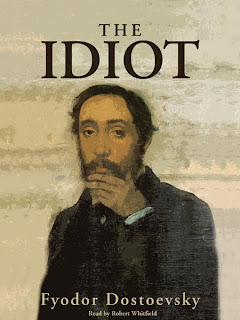
The Idiot


The Idiot by Fyodor Dostoevsky

"But all this had flown from his mind, everything except the one fact that she was sitting there beside him and that he was looking at her, and it made no difference to him then what she was talking about."

"For the prince, too, that morning began under the influence of painful forebodings; they could be explained by his state of illness, but his sadness was quite undefined and that was what made it most tormenting to him. It is true he was faced with facts that were clear, painful, and incisive, but his sadness went beyond everything he remembered and could reflect upon; he understood that he could not set his mind at rest again by himself."